Imagine walking down a forest path. You see trees towering overhead, a stream running beside the trail, and rocks scattered across your way. As you navigate, you instinctively step over the rocks, estimating how far each one is. This ability to perceive the world in three dimensions—to judge distances and understand the spatial relationships between objects—is what we call depth perception.
People use sensory information to guide their interactions with the environment. Like the majority of animals, people usually want to know where specific items in their environment are. Put simply, depth perception is the capacity to judge whether objects are closer or farther away from one another. Similarly, it is the ability to see the world in three dimensions.
Table of contents
What is Depth Perception?
Depth perception is your brain’s ability to interpret visual cues from both eyes to determine the distance and position of objects in space. It helps you:
- React quickly and with precision
- Move safely through your environment
- Gauge distances accurately
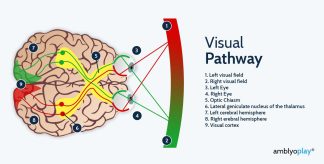
This ability depends on healthy binocular vision—where both eyes work together as a team. When one eye is weaker or misaligned, the brain may suppress its input, leading to poor depth perception.
Depth perception is a complex process that combines several cues to help us understand our environment. These cues are typically divided into two main categories: binocular cues and monocular cues.
Binocular Cues: Seeing with Two Eyes
Humans, like many animals, have binocular vision—that is, we see with two eyes. Our eyes are positioned slightly apart, so each one views the world from a slightly different angle. This difference, known as retinal disparity, provides a key binocular cue for depth perception.
- Retinal Disparity: Since our eyes are about 6 cm apart, each eye captures a slightly different image of an object. The brain processes these two images and uses the differences between them to calculate the object’s distance. The greater the disparity, or difference, between the two images, the closer the object is to us.
- Convergence: Another binocular cue comes from the muscles that control eye movement. When you focus on something close, your eyes turn inward slightly. The brain senses this convergence and uses it to gauge how near an object is. The more the eyes converge, the closer the object.
Monocular Cues: One Eye Is Enough
While binocular cues are crucial for depth perception, they aren’t the only ones we rely on. We can still perceive depth with one eye closed, thanks to monocular cues, which are often just as effective over longer distances. Some of the key monocular cues include:
- Size and Scaling: If two objects are known to be the same size, the smaller one will appear farther away. For example, if two cars are parked at different distances, the one that looks smaller is interpreted as being farther away.
- Perspective: Objects that are closer to the horizon appear farther away than objects lower or higher in the visual field. This is why a road appears to narrow as it stretches into the distance.
- Texture Gradient: Objects that are close to us show more detail and texture. As objects recede into the distance, their details become less distinct, giving us a sense of their depth.
- Motion Parallax: This occurs when we are in motion, such as riding in a car. Objects closer to us appear to move faster than objects in the distance. This difference in the speed of movement helps the brain determine how far away something is.
- Occlusion: When one object partially blocks or covers another, the blocked object is perceived to be farther away. This cue is often used in photography or painting to create a sense of depth.
How Does Depth Perception Impact Your Life?
Depth perception is one of the most important visual skills. Binocular vision, commonly referred to as stereopsis, is a prerequisite for depth perception.
If there is no binocular vision, you can rely on oculomotor cues from each eye separately. The brain makes numerous adjustments to compensate with the restricted visual input from one eye.
However, depth impairment definitely has an impact on life. It can decrease a kid’s ability to learn. Furthermore, there is difficulty driving and navigating the appropriate road. For sports professionals, the poor depth prevents the development of their full potential. What is more, it can also have an effect on career development as it prevents you from obtaining a position requiring strong depth perception skills.
Weak or inconsistent depth perception can affect:
- Driving and parking
- Playing sports
- Reading and learning (especially in kids)
- Walking on uneven surfaces or stairs
- Pouring drinks or reaching for objects

What Causes Impaired Depth Perception?
• Amblyopia (Lazy Eye):
A condition when the connection between the brain and eyes breaks down. Consequently, the brain is incapable of recognizing sight from one eye and the brain becomes increasingly reliant on the other, stronger eye over time, while vision in the weaker eye deteriorates.
• Strabismus (Eye Misalignment):
Crossed eyes or medically known as strabismus occurs when eyes are not aligned with each other. Furthermore, the brain is unable to coordinate eyes to work together. Strabismus is categorized into four groups by the direction of the eye misalignment, namely esotropia (inward turning), exotropia (outward turning), hypertropia (upward turning) and hypotropia (downward turning).
• Optic nerve hypoplasia:
When the optic nerve, which transmits visual signals from your eyes to your brain, does not fully develop before birth, this can happen.
• Blurry or uneven vision:
Vision can suddenly become blurry if there is an issue with any of your eye’s parts, including the cornea, retina, or optic nerve. However, there are numerous reasons for such condition.
• Trauma to one eye:
Eye injury can result in poor depth perception.
Depth Perception Test: How Is Depth Perception Measured?
An optometrist can perform a binocular vision assessment using tools such as:
- Stereoacuity tests: Check how well both eyes detect fine differences in depth
- Random dot stereograms: Evaluate 3D vision without visual cues
- Titmus Fly Test: A fun, interactive test often used for kids
Depth perception tests often involve visual tasks where a person must distinguish which object is closer or farther away, using both binocular (two-eye) and monocular (one-eye) cues.

Can Depth Perception Be Improved?
Yes—if the root cause is diagnosed and treated properly. If you’re experiencing problems with depth judgement:
- Book a full binocular vision exam
- Work with a behavioural optometrist or vision therapy provider
- Start a structured depth perception and vision therapy programme
Firstly, visit your optometrist or ophthalmologist to find the underlying reason for the poor depth. You will get the appropriate treatment plan.
The simplest levels of intervention use straightforward methods like eye exercises, limiting screen time, taking rest on the dominant eye, or improved lighting.
Vision Therapy Exercises for Depth Perception
Here are some common tools and methods used in therapy:
- Brock String: Trains eye alignment by focusing on beads placed at different distances along a string.
- Red/Green Filters: Each eye sees a different image, encouraging fusion and anti-suppression.
- Computer and VR Training: Gamified therapy improves tracking, focus, and stereoscopic skills.
- Prism Lenses: Shift light to improve eye coordination and depth perception.
All exercises are tailored to the patient’s needs and monitored by a professional for best results.
If the cause is amblyopia or strabismus, the treatment will focus on making the weaker eye stronger. This can be accomplished using eyeglasses, wearing an eye patch, performing digital vision therapy exercises, or VR.
To teach the eyes and brain how to work together, we suggest the binocular approach of treatment. However, some issues cannot be treated with the mentioned approaches, requiring eye muscle surgery to enhance depth perception.

Conclusion
Depth perception and vision therapy go hand in hand. Whether you’re a child with a lazy eye or an adult struggling with spatial awareness, vision therapy can retrain the brain and improve how your eyes work together—restoring confidence and clarity in everyday life.
Frequently Asked Questions
Is it too late to improve depth perception as an adult?
Not at all. While early intervention is ideal, adults can still benefit from vision therapy programmes.
How long does vision therapy take to improve depth perception?
Results vary, but most patients see improvement within 6–12 weeks of regular therapy.
Source:
1. Depth Perception: What Is It and How Does It Work? (2022, September 6). Verywell Health. https://www.verywellhealth.com/depth-perception-3421547