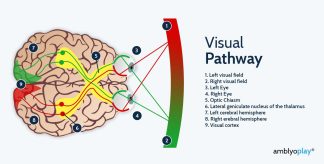
People often believe that strabismus somewhat equals amblyopia and vice versa, and whilst these two often coexist they should not be inherently considered as coinciding entities. This blog post will explore the key differences between amblyopia vs strabismus, their causes, symptoms, and a practical example to illustrate their impact on daily life.
Table of contents
What is Amblyopia?
Amblyopia, as you are probably aware, is a disorder that is characterized by decreased visual function (visual acuity, contrast sensitivity, etc.) without any detectable pathological abnormalities of the eye.
This condition typically starts in childhood when the brain and the eyes are not working together properly. Over time, the brain begins to favor one eye over the other, leading to decreased vision in the affected eye. Understanding amblyopia vs strabismus is key to effective treatment.
Causes of Amblyopia
- Strabismus (eye misalignment): When the eyes are misaligned, the brain may ignore input from the misaligned eye to avoid double vision, leading to amblyopia.
- Uncorrected refractive errors: Significant differences in the refractive power of each eye can cause amblyopia if one eye is more nearsighted, farsighted, or astigmatic than the other.
- Deprivation: Conditions that obstruct vision in one eye, such as cataracts, can cause amblyopia.
It is a disorder that practically never arises by itself – it is always triggered by another underlying condition. Even though visual deprivation such as congenital cataracts, for instance, does trigger severe amblyopia, it is most commonly caused by unrecognized refractive errors such as anisometropia, followed closely by – yes you have guessed it – strabismus.
Symptoms of Amblyopia
Symptoms of amblyopia include:
- Poor depth perception
- Reduced visual acuity
- Head tilting
- Difficulties with activities that require clear binocular vision, such as reading or playing sports.
Treatment of Amblyopia
The treatment of amblyopia consists of (A) treatment of the cause and (B) treatment of amblyopia itself.
(A) Treatment of the cause very much depends on the actual cause and is sometimes enough to halt the amblyopia progression.
(B) Treatment of amblyopia itself, on the other hand, is aimed specifically to restore the visual function and consists of vision therapy approaches.
What is Strabismus?
Strabismus or crossed eyes is a condition characterized by eye misalignment. It can be classified as congenital, acquired, or secondary to other ocular pathology. Comparing amblyopia vs strabismus helps in identifying the unique treatment paths for each condition.
Causes of Strabismus
Strabismus can develop for various reasons, including muscle imbalances, nerve issues, or problems with eye movement control.
- Muscle imbalance: Six muscles control eye movement. If these muscles are imbalanced, it can cause strabismus.
- Neurological issues: Problems with the brain’s control of eye muscles can lead to strabismus.
- Genetics: Family history can increase the risk of developing strabismus.
Symptoms of Strabismus
In children, it may or may not cause amblyopia. Luckily, eye misalignment is usually very easy to spot and kids with strabismus are often referred to an ophthalmologist early.Strabismus may result in:
- Crossed eyes
- Double vision
- Eye strain
- Reduction in depth perception.
Treatment of Strabismus
Therefore, the treatment of strabismus and possible overlying amblyopia is usually initiated early, which maximizes treatment success.
Although certain forms of strabismus can cure on their own, sometimes a special treatment with a combination of specialized prisms glasses, medication, or surgery is needed in order to reduce the eye misalignment.
Amblyopia vs Strabismus: Key Differences
| Amblyopia | Strabismus | ||
| Nature of the condition | Amblyopia is primarily a vision-related neurological development disorder resulting from the brain favouring one eye over the other. | Strabismus is a misalignment of the eyes, leading to a lack of coordination between them. | |
| Symptoms | Reduced vision, poor depth perception, and difficulties with binocular activities. | Visible eye misalignment, double vision, and eye strain. | |
| Treatment Focus | Amblyopia treatment focuses on promoting the use of the weaker eye through corrective measures like glasses and vision therapy. | Strabismus treatment aims to correct the misalignment, often through glasses, vision therapy, or surgery. |
Practical Example of Amblyopia vs. Strabismus: Doctor Diagnosed Strabismus
Imagine a child named Emma, who is 6 years old. Emma’s parents notice that she often tilts her head to one side and occasionally squints one eye when trying to focus on something. Concerned, they take her to an eye specialist.
After a thorough examination, the doctor diagnoses Emma with strabismus. Her left eye turns slightly inward, especially when she is tired or focusing on near objects. The doctor also identifies that Emma has amblyopia in her left eye due to the strabismus causing her brain to ignore the input from that eye to prevent double vision. This practical example of amblyopia vs strabismus highlights their interplay.
Treatment Plan:
- For Strabismus: Emma is prescribed special glasses to help with the alignment and may also undergo vision therapy to improve muscle control. In some cases, surgery might be recommended to correct the muscle imbalance.
- For Amblyopia: To treat the amblyopia, Emma’s parents are advised to patch her stronger eye for a few hours each day. This forces her brain to use the weaker eye, thereby improving its vision over time. Additionally, eye drops that blur vision in the stronger eye might be used as an alternative to patching. Moreover, eye exercises on tablet or computer are another option for vision therapy homework.
As Emma follows her treatment plan, her parents notice gradual improvements. Her eyes start to align better, and the vision in her left eye improves significantly. Emma’s experience underscores the importance of early diagnosis and intervention in managing both amblyopia vs strabismus.
Conclusion: Amblyopia vs Strabismus
Understanding the differences between amblyopia vs strabismus is essential for proper diagnosis and treatment. In conclusion, while amblyopia and strabismus can coincide, not every amblyopia is caused by strabismus, and not every strabismus will lead to the development of amblyopia.
Amblyopia is primarily a brain-vision issue, while strabismus is related to eye alignment.
If, however, amblyopia is caused by underlying strabismus, a combination of a treatment aimed specifically at amblyopia and a treatment designed specifically for strabismus will provide the best results.
What comes first will usually be decided on an individual basis. A high-quality vision therapy computer or tablet programme such as AmblyoPlay can nonetheless be effective in treating amblyopia caused by either strabismus or any other reason for that matter.

Regular eye examinations, especially in childhood, are essential for identifying and addressing these issues early on.
Frequently Asked Questions
Can amblyopia and strabismus occur together?
Yes, it is possible for amblyopia and strabismus to coexist. In some cases, the misalignment of the eyes in strabismus can lead to amblyopia.
Are these conditions only found in children, or can adults develop amblyopia and strabismus as well?
While amblyopia and strabismus often manifest in childhood, they can affect individuals of any age. In adults, these conditions may result from various factors, including eye muscle imbalances, trauma, or neurological issues.
How can parents or individuals recognize the signs of amblyopia and strabismus in their children or themselves?
Signs of amblyopia in children may include poor depth perception, squinting, or complaints of blurry vision. Strabismus is often noticeable through the misalignment of the eyes. Regular eye examinations, especially during early childhood, can help detect these conditions. In adults, symptoms like double vision or eye strain may indicate the presence of strabismus.