At AmblyoPlay, we are committed to continuous innovation to ensure our users receive the most effective and engaging vision therapy. We are excited to introduce Active Peripheral Stimulation (APS), a unique, and in-house innovation to stimulate your peripheral vision even more, together with all other visual skills that AmblyoPlay games are already targeting.
The feature is added to all our existing games. We are proud to be the first in the industry to integrate these groundbreaking scientific findings into vision therapy.
Table of contents
- Peripheral Vision Meaning
- What is Peripheral Vision Stimulation?
- Scientific Background for Developing an Active Peripheral Simulation (APS) Concept
- How Is APS Implemented Into the AmblyoPlay Games?
- Why Active Peripheral Stimulation (APS)?
- Join Us on This Exciting Journey!
- Conclusion
- Frequently Asked Questions About Peripheral Stimulation
Peripheral Vision Meaning
Peripheral vision refers to the part of vision that occurs outside the very center of your gaze. It encompasses the ability to see objects and movement in your surroundings without having to look directly at them.
This type of vision is essential for detecting motion, navigating through environments, and maintaining overall spatial awareness.
Peripheral vision is less sharp than central vision, which is focused directly in front of you, but it is particularly sensitive to movement and plays a crucial role in tasks like driving, sports, and even everyday activities like walking. It also helps in detecting threats or changes in the environment without needing to constantly shift focus.
What is Peripheral Vision Stimulation?
Peripheral vision stimulation entails increasing visual signal input from all directions on the screen. This method uses both central and peripheral vision, providing a comprehensive visual therapy experience.
A unique technology enables maximizing cortical activity/stimulation through playing advanced therapeutic games in order to reach the highest training efficiency.
Exercises or activities are designed based on the “sweet spot training method” to target an optimal level of intensity or engagement for maximum benefit, which is set between 85 and 95% of individual maximum visual skill capacity.
APS consists of two active parts:
• Central targets in the games generate the visually evoked cortical potential (VECP) through the foveal response.
• Parafoveal area is stimulated by the dynamic background game stimuli.
Scientific Background for Developing an Active Peripheral Simulation (APS) Concept
Our development of Active peripheral stimulation (APS) is grounded in the scientific principles. This scientific research is detailed in “Visual Perception: A Clinical Orientation, Fifth Edition” by Steven H. Schwartz. It focuses on the electrophysiological methods used to study and measure visual function and neural activity in the visual system.
Electrophysiological Techniques
- Electroretinogram (ERG): ERG measures the electrical response of the retina to light stimulus, detailing different components such as the a-wave and b-wave. These components are clinically relevant for diagnosing retinal disorders. APS leverages the principles of ERG by creating visual stimuli that enhance retinal response through dynamic and engaging backgrounds.
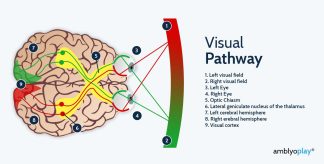
- Visual Evoked Potentials (VEP): VEP measures the electrical activity in the visual cortex in response to visual stimuli, highlighting its application in assessing the functional integrity of the visual pathways from the retina to the visual cortex. By incorporating elements that stimulate peripheral vision, APS aims to enhance the neural activity captured by VEP, providing a more comprehensive visual training experience.
Applications in Clinical Practice
- Diagnosis and Monitoring: ERG and VEP are used in diagnosing conditions like retinitis pigmentosa, optic neuropathies, and multiple sclerosis. These tests help monitor disease progression and the efficacy of treatments. Active peripheral stimulation (APS) can be integrated into these clinical practices by providing additional peripheral visual stimuli that can improve the diagnostic precision and therapeutic outcomes.
- Research and Development: Electrophysiological techniques play a crucial role in research, providing insights into normal and pathological visual processing. APS can improve research methodologies by offering a new dimension of peripheral stimulation, contributing to a deeper understanding of visual system functionality.
Technical Considerations
- Methodology: Conducting ERG and VEP involves specific protocols including patient preparation, electrode placement, and stimulus parameters. Active peripheral stimulation (APS) adheres to these rigorous standards by ensuring that the visual stimuli used in our games are designed to optimize peripheral visual engagement without compromising the integrity of these established methodologies.
- Data Interpretation: Interpreting waveforms and patterns from ERG and VEP tests requires consideration of factors like age, ocular health, and specific conditions. APS-enhanced games are designed to provide consistent and reliable peripheral stimuli that can aid in the accurate interpretation of these electrophysiological tests.
How Is APS Implemented Into the AmblyoPlay Games?
Our new APS feature introduces different stimulating components to our games, making them more dynamic and challenging for your peripheral vision.
Dynamic Backgrounds
Engaging players in settings that change, swirl, and disappear. They feature elements like fireworks, rockets and falling leaves.
Moving Objects
Notice moving objects in the background, such as leaves and flickering stars. These elements will appear and disappear, providing a continuous visual challenge for your peripheral vision.

Why Active Peripheral Stimulation (APS)?
APS is an improvement to our existing games that takes the full potential of peripheral vision stimulation. By integrating these elements, we are upgrading the standard of vision therapy, making it more effective for peripheral vision.
As the first in the industry to offer high peripheral stimulation within the vision therapy program, AmblyoPlay is setting a new benchmark for vision therapy solutions.
Join Us on This Exciting Journey!
We invite you to experience APS and discover the enhanced benefits of our vision therapy games. Stay tuned for updates, new features, and more as we continue to innovate and improve our offerings.
Conclusion
At AmblyoPlay, we strive to push the boundaries of vision therapy. With Active Peripheral Stimulation (APS), we are improving our games to provide a more comprehensive training experience for your peripheral vision.
In conclusion, APS consists of two active parts. Firstly, central targets in the games that generate the visually evoked cortical potential (VECP) through the foveal response. Secondly, parafoveal area is stimulated by the dynamic background game stimuli. Try APS today and take your vision therapy to the next level!
Frequently Asked Questions About Peripheral Stimulation
What is Active Peripheral Stimulation (APS) and how does it improve vision therapy?
APS is an in-house innovation at AmblyoPlay that enhances peripheral vision stimulation. It works by incorporating dynamic visual effects in our therapeutic games to target the parafoveal area (outside the central gaze). This stimulation helps improve spatial awareness, motion detection, and overall peripheral vision, making vision therapy more engaging and effective.
How is APS integrated into AmblyoPlay games?
APS is embedded into all existing AmblyoPlay games. It uses various visual techniques such as moving objects, zoom effects, and dynamic backgrounds to stimulate the peripheral vision. For example, backgrounds may simulate environmental effects like waves or snowfall, while zoom effects mimic real-life experiences like driving. These enhancements create a comprehensive visual challenge, actively engaging both the central and peripheral vision.
Why is peripheral vision important, and how does APS help improve it?
Peripheral vision allows us to detect movement and changes in our environment without looking directly at them. It plays a key role in tasks like driving, playing sports, and maintaining spatial awareness. APS focuses on improving this type of vision by providing targeted visual stimuli designed to enhance peripheral vision’s sensitivity to motion and depth perception, resulting in more well-rounded visual skills.